


ACT


August 31, 2026
Most articles about safe ratings are written by people who sell safes, not people who make them. Dominator Safes is a Western Australian manufacturer, sold throughout Australia and New Zealand, and where a series carries independent testing, that rating is earned on its own terms — and we will tell you plainly which models are certified and which are built to Dominator’s own engineering standards. We can tell you exactly what each one means, what it doesn’t cover, and where the gaps in the marketing usually sit.
There are four rating systems buyers run into, and they’re often confused with each other: a cash rating (what an insurer will require), AS/NZS 3809 (the Australian and New Zealand burglary resistance standard), EN 1143-1 (the European grade system some imported safes carry), and UL TL-15 / TL-30 (the US tool resistance standard, and the one most searched in Australia because it’s stamped on so many imported units). None of them measure the same thing, and a safe can pass one comfortably while saying nothing about the others.
This guide walks through each standard on its own terms, shows how they line up side by side, and explains how to check what a specific safe has actually been tested to, rather than what a brochure implies.
Four rating systems that measure four different things
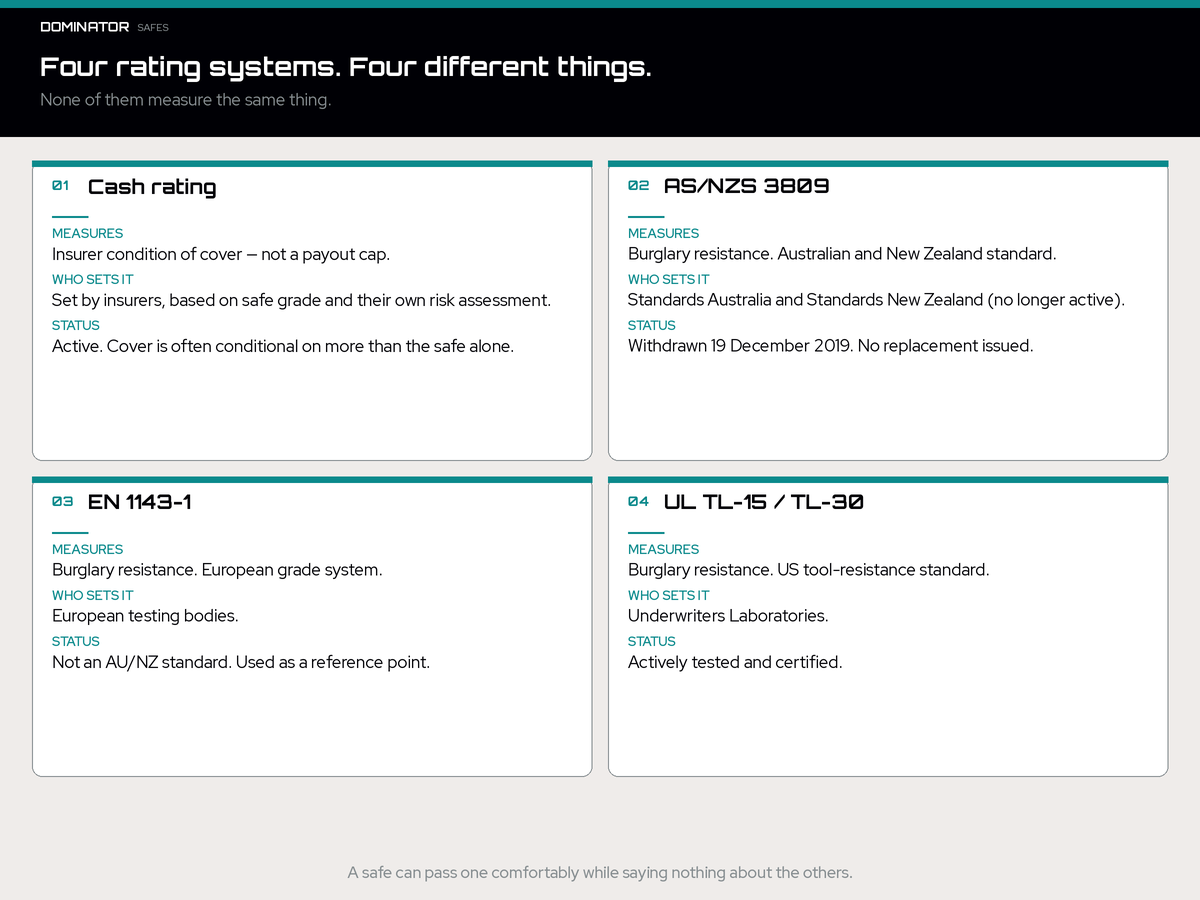
| Cash Rating | AS/NZS 3809:1998 | EN 1143-1 | UL TL-15 / TL-30 | |
|---|---|---|---|---|
| What it measures | The safe rating required to insure contents at a given sum insured, not a payout cap, but a condition of cover | Burglary resistance (Australian and New Zealand standard, withdrawn 2019) | Burglary resistance (European standard) | Burglary resistance (US standard) |
| Who sets it | Insurers, based on safe grade and their own risk assessment | Standards Australia and Standards New Zealand (no longer active) | European testing bodies | Underwriters Laboratories |
| Current status in Australia and New Zealand | Active, insurers set their own requirements | Withdrawn 19 December 2019, no replacement issued in either country | Not an Australian or New Zealand standard, but used as a reference point | Actively tested and certified |
| Still relevant because | Without a compliant rated safe, insurers may decline to cover the goods at all, regardless of your policy limit. Cover is often conditional on more than the safe alone: monitored alarms, correct anchoring or bolting, and sensor placement can all factor into what an insurer will endorse | Still referenced in some regulations, and grades are still quoted on manufacturer documentation, cross referenced against active standards | Provides the internationally recognised grade ladder that AS/NZS 3809 itself was built from | Widely tested standard for safes sold in Australia and New Zealand; lab minutes of resistance to specified tools |
| Example figure | Chubb Insurance endorses Dominator safes at 10x cash rating, e.g. a safe with a $100,000 cash rating supports up to $1,000,000 in insured contents | Grade 2 | Grade 2 | TL-15 (15 minutes) |
A safe can be UL tested, hold an EN equivalent grade, and still carry an AS/NZS 3809 reference on its paperwork. These aren’t competing claims, they’re four different lenses on the same safe.
Cash rating isn’t just about the safe itself. Insurers typically look at the full picture: the safe’s rating, whether it’s correctly bolted or anchored, and in many cases whether the premises has a monitored alarm system with sensors covering the safe’s location. Chubb Insurance, for example, endorses Dominator safes at 10x cash rating, meaning a safe with a $100,000 rating supports up to $1,000,000 in insured contents. That endorsement sits within Chubb’s broader security requirements, not the safe rating alone.
AS/NZS 3809: the standard that’s still quoted, even though it’s withdrawn
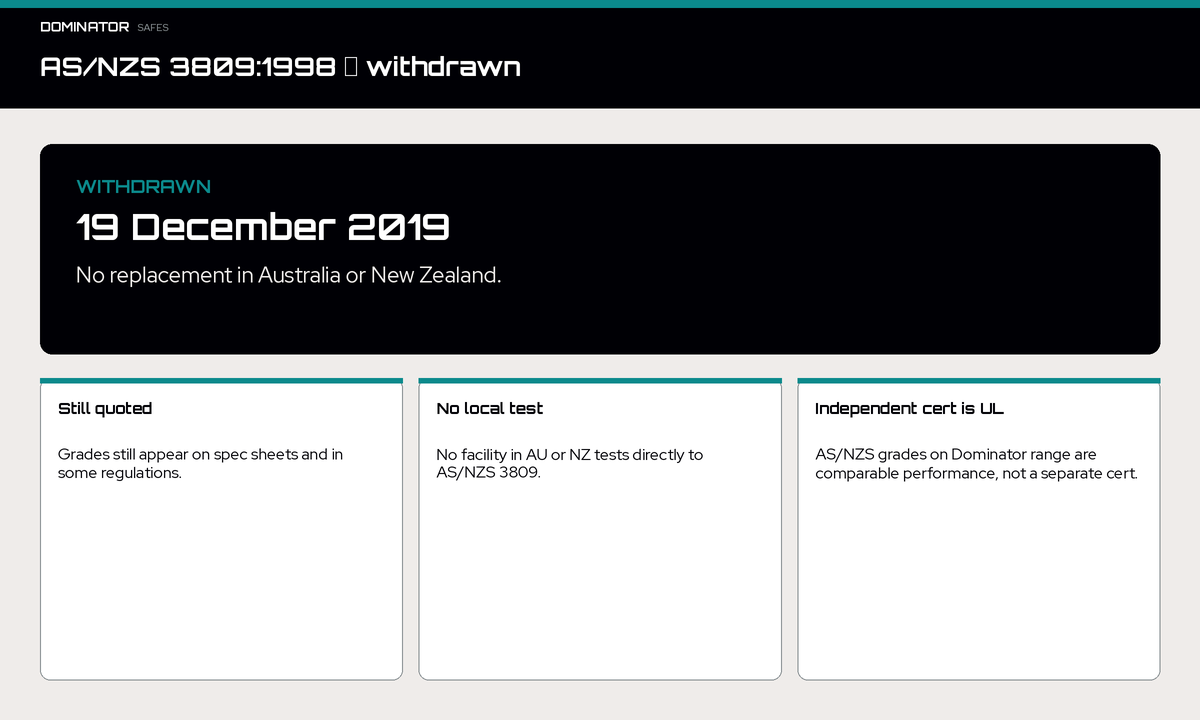
If you’ve been shopping for a safe in Australia or New Zealand, you’ve probably seen “AS/NZS 3809” or a Grade 2 / Grade 3 rating on a spec sheet. Here’s what buyers usually aren’t told: AS/NZS 3809:1998 was formally withdrawn on 19 December 2019, and no replacement standard has been issued since, in either country.
That doesn’t mean the standard has disappeared from the conversation. A few things kept it alive in practice:
- No local test facility exists in either country. Testing to AS/NZS 3809 would have meant sending Australian or New Zealand made safes overseas for certification. The standard’s resistance and grading tables were drawn directly from the European EN 1143-1 standard rather than developed independently, so a facility offering genuine AS/NZS 3809 testing never really had a separate methodology to test against.
- Cash rating mapping wasn’t consistent internationally. Even within Europe, the same EN grade doesn’t get the same insurance cash rating applied from country to country. The mapping reflects local risk assessment, not just currency conversion, so a single joint Australian and New Zealand standard built on that ladder had an inherent inconsistency problem.
- Regulations move slower than standards. Legislation that references specific safe grades, such as firearms storage rules, pharmaceutical storage requirements, and some insurance policy wording, doesn’t get rewritten every time a standard changes. WA’s firearms storage regulations, for example, were only updated in December 2024, more than 50 years after the original 1974 Act. A grade reference from a 1998 standard can still be sitting in force today simply because nothing has replaced it in the regulation itself.
What this means in practice: because no facility can test directly against AS/NZS 3809 in Australia or New Zealand, safes today aren’t independently certified to it. Instead, an AS/NZS 3809 grade can be determined by calculating equivalent tool resistance and time using the same tool kit methodology the standard specifies, cross referencing against results from an active standard like UL. That’s the basis for the AS/NZS 3809 grades quoted on Dominator’s own range, sold across both markets:
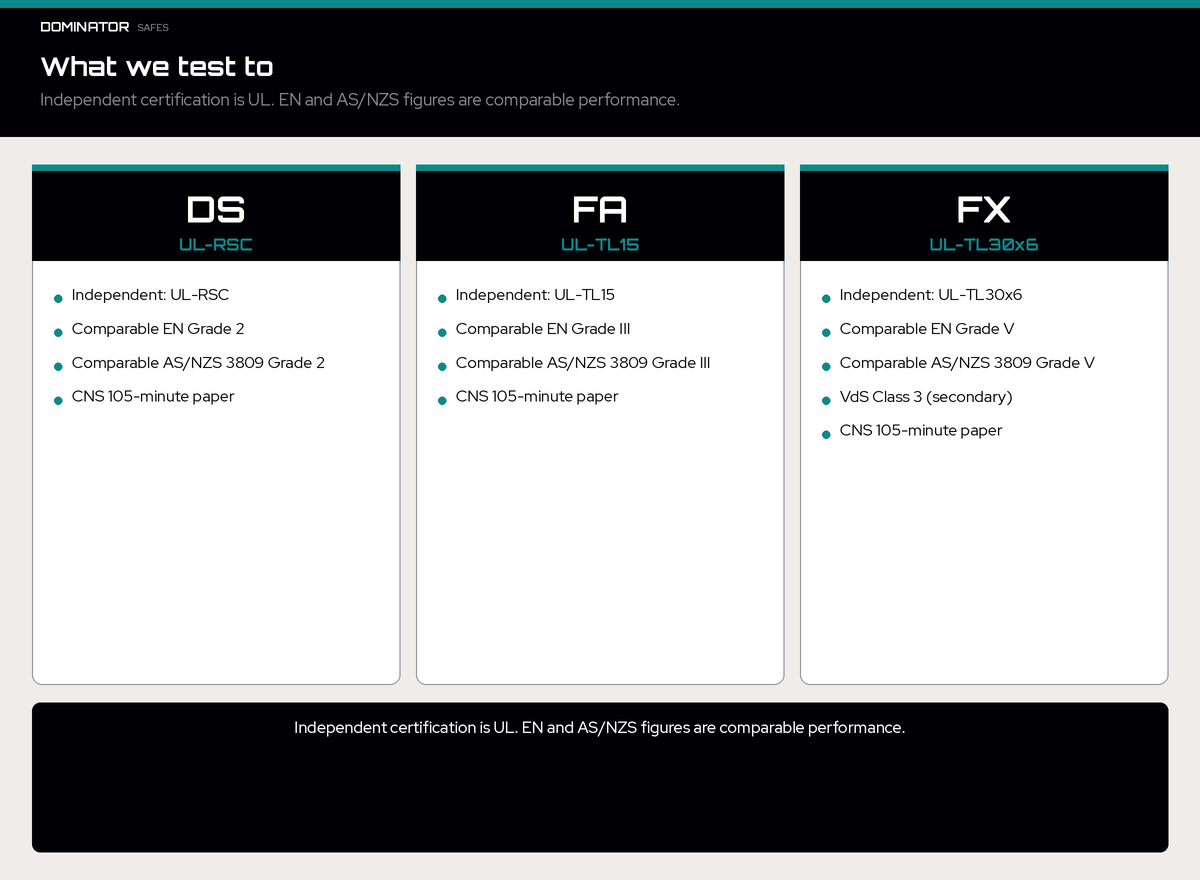
- DS Series: independently tested and certified to UL-RSC. Performance comparable to EN 1143-1 Grade 2 and AS/NZS 3809:1998 Grade 2.
- FA Series: independently tested and certified to UL-TL15. Performance comparable to EN 1143-1 Grade III and AS/NZS 3809:1998 Grade III.
- FX Series: independently tested and certified to UL-TL30x6. Performance comparable to EN 1143-1 Grade V and AS/NZS 3809:1998 Grade V.
The independent certification is UL. The AS/NZS 3809 and EN 1143-1 figures are stated as comparable performance, not as separate independent test results, an important distinction if you’re relying on a specific grade for a regulatory or insurance requirement, and one worth confirming directly with whoever administers that requirement.
EN 1143-1 and the grade ladder AS/NZS 3809 was built from
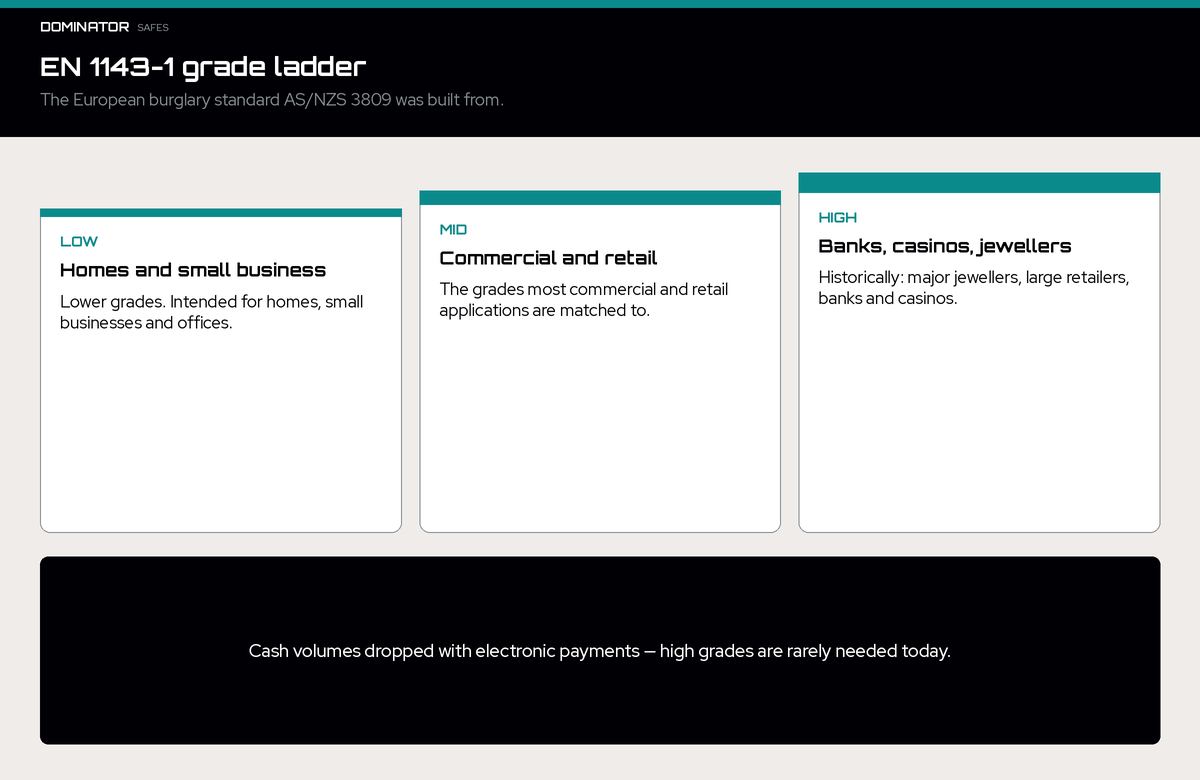
EN 1143-1 is the European standard for burglary resistant safes and strongrooms, and it’s the standard AS/NZS 3809 itself was based on rather than developed independently. Both use the same underlying concept: a safe accumulates resistance units based on the time and difficulty of breaching it using a defined kit of tools, and that score determines its grade.
The ladder runs from Grade 0 at the low end up through progressively higher grades, with each step representing a significant jump in tested resistance rather than a small incremental improvement. At the lower end sit safes intended for homes, small businesses and offices. In the middle sit the grades most commercial and retail applications are matched to. At the top end, historically, sat the grades built for major jewellers, large retailers, financial institutions, banks and casinos, the kind of premises expected to hold substantial cash or valuables on site at any given time.
Why you rarely see high grades quoted today
At the time this ladder was most actively used, Australia and New Zealand were still largely cash based economies. Banks, bullion dealers and high volume jewellers routinely held enough physical cash or stock on premises to justify a high grade safe, and in some cases a vault. With electronic payments now accounting for more than 80% of transactions, the volume of cash sitting in most commercial premises has dropped sharply, and the practical need for anything above the mid range grades has largely gone with it. Most businesses today are matched to a lower grade not because higher grades stopped existing, but because the amount of cash or valuables actually being stored no longer justifies them.
The important point for buyers: an EN 1143-1 or equivalent grade tells you how hard a safe is to breach. It does not, on its own, tell you what cash value an insurer will let you store inside it. That mapping is set independently by each insurer, and it varies between insurers and between countries, which is part of why AS/NZS 3809 struggled to establish one consistent Australian and New Zealand figure when it borrowed this same ladder. If you’re choosing a safe based on a required cash rating, the grade is the starting point for that conversation with your insurer, not the final answer.
Where Dominator’s own range sits on this ladder:
- DS Series: independently tested and certified by UL to UL-RSC; performance aligns with the EN 1143-1 Grade II class. This is not a separate EN/ECB•S/AS/NZS laboratory certificate—the named certificate is UL-RSC.
- FA Series: performance comparable to EN 1143-1 Grade III
- FX Series: performance comparable to EN 1143-1 Grade V
Browse the ranges:
DS Series
FA Series
FX Series
Find a dealer or
Request a quote
UL TL-15 and TL-30: what the numbers actually mean
Underwriters Laboratories (UL) is the US based testing body behind one of the most widely quoted rating systems on safes sold in Australia, and it’s also the most misunderstood. The confusion usually starts with the name itself.
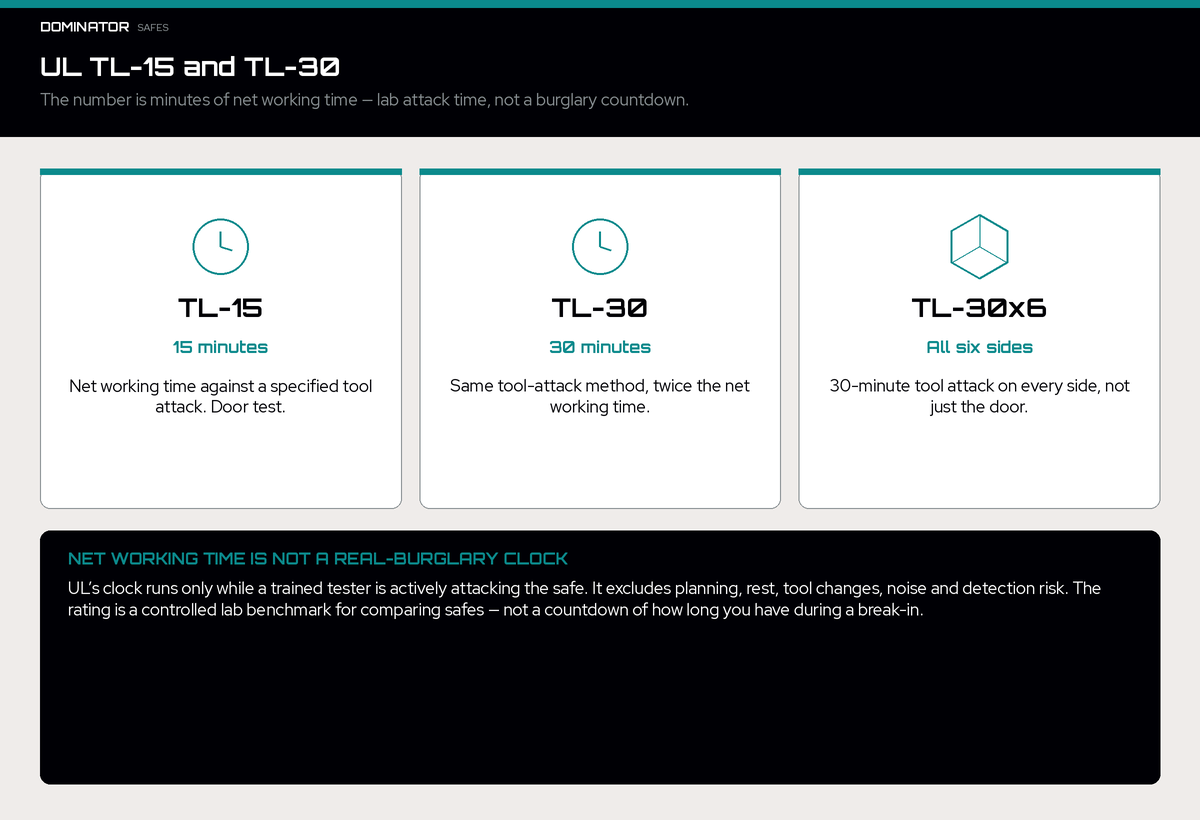
TL stands for tool. The number is minutes, but not the minutes you’re picturing.
A UL TL-15 rating means a safe withstood a specified attack, using a defined kit of common hand and power tools, for a net working time of 15 minutes without failing. TL-30 means 30 minutes under the same conditions. The “TL30x6” designation on a safe means it has passed that same 30 minute tool attack test on all six sides of the unit, not just the door, which matters because a determined attacker doesn’t necessarily go through the front.
The part that trips people up is “net working time.” UL’s clock only runs while a trained tester is actively attacking the safe with tools in hand. It excludes time spent planning, resting, swapping tools, or working around noise and detection risk, all of which slow down a real intruder considerably. A TL-15 rating is not a promise that a safe will survive 15 minutes in a real burglary. In practice, a real attacker without lab conditions, a fixed toolkit, or unlimited confidence usually takes considerably longer to achieve what a tester does in the allotted lab time. The rating is a controlled, repeatable benchmark for comparing safes against each other, not a countdown clock for how long you have during an actual break in.
Where Dominator’s range sits on this scale:
- DS Series is independently tested and certified by UL to UL-RSC, a real third-party UL laboratory standard. For homeowners, UL-RSC is a much higher burglary bar than light European home duals, including EN 14450 S2 home duals. Dominator DS RSC performance sits in the EN 1143-1 Grade II class—above EN 14450 S2 and S1, and above EN 1143-1 Grade 0 and Grade I—by alignment/equivalency, but the named certificate is UL-RSC—not an EN, ECB•S or AS/NZS laboratory certificate. DS safes also carry CNS 105-minute certified fire. On the UL ladder, RSC sits below UL-TL15 (FA) and UL-TL30x6 (FX), which are higher tool-attack commercial tiers.
- FA Series is independently tested and certified to UL-TL15, withstanding the full 15 minute tool attack test.
- FX Series is independently tested and certified to UL-TL30x6, the highest tier in Dominator’s range, tested against a 30 minute tool attack on every side of the safe rather than the door alone. The FX Series has also achieved VdS Class 3 certification, a respected European testing standard, as a secondary certification alongside its UL-TL30x6 rating.
Two safes can both carry a TL-15 label and still differ in real world security, because the rating only confirms a pass or fail against a specific test, not the total margin by which a safe exceeded it. This is where knowing who actually built and tested the safe starts to matter more than the label alone.
Fire ratings are a separate system entirely
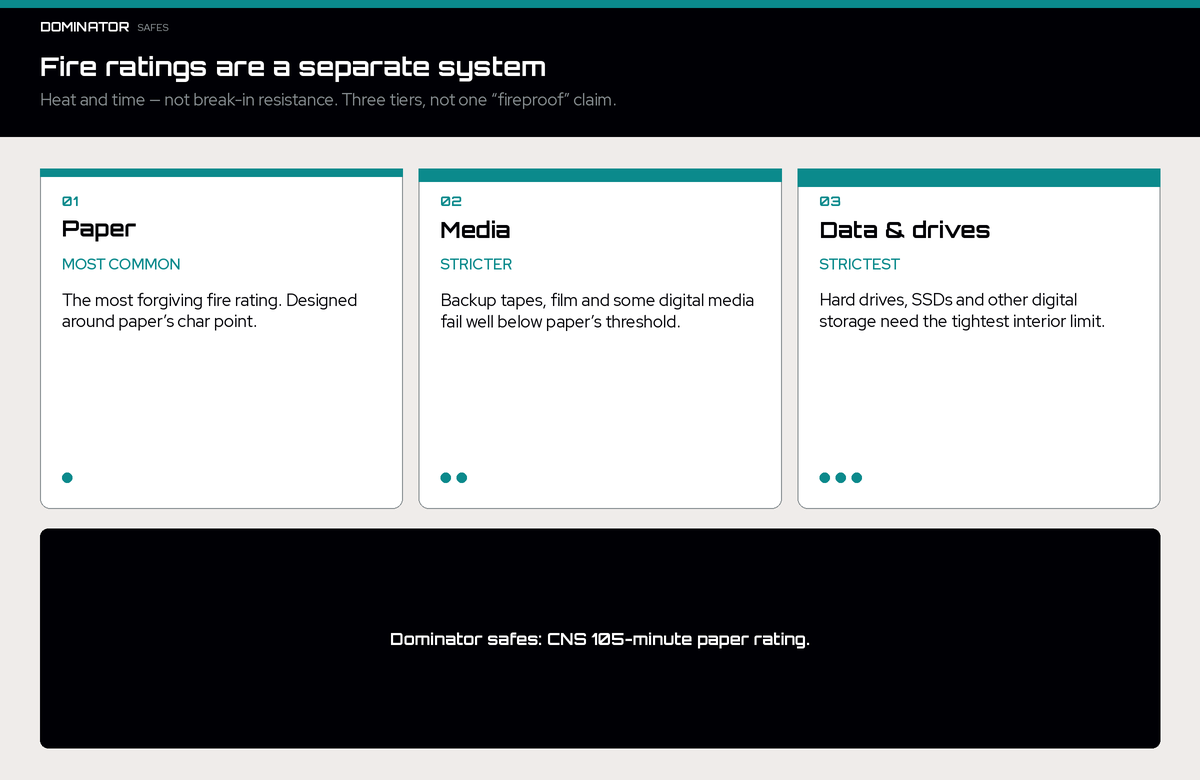
This is where we see the biggest misconception among buyers, and it’s an easy one to fall into: assuming that a safe rated for burglary resistance also protects against fire, or that a fire rated safe is automatically also secure against a break in. They’re two completely different systems, tested against completely different threats, and a safe can excel at one while offering little to no protection against the other.
Fire ratings measure heat and time, not break in resistance. A fire rating tells you how long the interior of a safe stays below a critical temperature threshold while the outside is exposed to fire. It says nothing about how resistant that same safe is to someone attacking it with tools. Equally, a safe with an excellent burglary rating like a UL-TL30x6 isn’t automatically fire rated just because it’s exceptionally well built. Fire protection and burglary protection are engineered differently, and a genuinely well rounded safe needs to be tested and rated for both independently.
Not all fire ratings protect the same contents. This is the part that catches people out most often, because “fireproof safe” gets used as a single, all encompassing marketing term when it isn’t:
- Paper ratings are the most common and the most forgiving. Paper chars at around 200°C, so a paper rated safe is designed to keep its interior below that threshold for a stated period.
- Media ratings are stricter again. Backup tapes, film and some forms of digital storage media can be damaged well below 200°C, so a media rated safe has to maintain a lower internal temperature to genuinely protect what’s inside.
- Data and drive ratings are the strictest of all. Hard drives, SSDs and other digital storage can suffer damage or data loss at temperatures far lower than either paper or traditional media, and a safe rated for paper alone offers no meaningful guarantee for a hard drive sitting inside it.
A safe marketed simply as “fireproof” without specifying which of these it’s rated for isn’t giving you enough information to know what it will actually protect. If you’re storing a mix of documents, jewellery, and digital backups, it’s worth checking which rating applies to which contents, because the safest assumption is the strictest one, not the most convenient one.
Where Dominator’s fire protection sits: Dominator safes are certified to CNS, achieving a 105 minute paper rating. Australian currency has been polymer, not paper, since 1988. Polymer notes are a plastic film that begins to soften and distort at temperatures considerably lower than paper’s char point, meaning a fire rating built around paper protection may not be enough to keep modern Australian cash intact. If you’re storing cash, digital backups, or other media alongside documents, it’s worth checking what your safe’s specific fire rating was designed to protect.
What we test to, and how to check any safe’s certification
With so many rating systems in play, and so much marketing language that blurs the lines between them, the most useful thing a buyer can do is ask a simple question before purchasing: what has this specific safe actually been tested and certified to, by whom, and does documentation exist to prove it?
A legitimate certification should be traceable. UL, VdS and CNS certifications are issued against specific test reports, tied to a specific model, not a general claim printed on a brochure. If a retailer or manufacturer can’t tell you which lab tested the safe, which standard it was tested against, or produce a certificate or test report number on request, that’s worth treating as a gap, not a technicality.
What Dominator tests to, in summary:
- DS Series: independently tested and certified by UL to UL-RSC, with performance aligned to the EN 1143-1 Grade II class—above EN 14450 S2 and S1 and EN 1143-1 Grade 0 and Grade I. It is not separately certified to EN/ECB•S/AS/NZS as a lab certificate; the named certificate is UL-RSC. CNS certified to a 105-minute paper fire rating.
- FA Series: UL-TL15, with performance comparable to EN 1143-1 Grade III and AS/NZS 3809:1998 Grade III, and CNS certified to a 105 minute paper fire rating.
- FX Series: UL-TL30x6, with performance comparable to EN 1143-1 Grade V and AS/NZS 3809:1998 Grade V, VdS Class 3 as a secondary certification, and CNS certified to a 105 minute paper fire rating.
Every certification listed above sits behind an independent test report, not a marketing claim we’ve assigned to our own products.
Getting documentation for your own compliance needs. If you need to demonstrate a safe’s certification for an insurance requirement, a regulatory application, or an internal compliance process, Dominator can supply the relevant compliance certificate for your specific unit on request. This is something our team prepares directly, drawing on the certified test documentation behind each model, so you get paperwork that actually corresponds to the safe you’ve purchased rather than a generic spec sheet.
FAQ
What is AS/NZS 3809?
AS/NZS 3809:1998 was the Australian and New Zealand standard for safes and strongrooms, based on Europe’s EN 1143-1. It was formally withdrawn on 19 December 2019 with no replacement issued. Its grade references still appear in some regulations and on manufacturer documentation, calculated by cross referencing results from active standards like UL.
What is a Grade 2 safe?
EN 14450 S2 and S1 are lighter European home dual categories. EN 1143-1 Grade II is a higher burglary-resistance class—above EN 14450 S2, S1, and EN 1143-1 Grade 0 and Grade I. Dominator DS RSC performance sits in that Grade II class by alignment/equivalency, but Dominator DS proof is independent UL-RSC certification, not an EN/ECB•S certificate. DS also carries CNS 105-minute certified fire. So when you see “Grade 2,” check which standard is meant: S2 is not EN 1143-1 Grade II.
What is a Grade 3 safe?
A Grade 3 safe meets a higher tested resistance level than Grade 2, reflecting a longer withstand time against a defined attack. Dominator’s FA Series, independently tested and certified to UL-TL15, has performance comparable to EN 1143-1 Grade III and the equivalent AS/NZS 3809:1998 grade.
What are the different classifications of safes?
Safes are classified by what they’re tested against. Burglary resistance uses systems like AS/NZS 3809, EN 1143-1, and UL TL-15/TL-30. Fire resistance is a separate system entirely, with paper, media, and data ratings each protecting different contents. Cash rating is a further, insurer set classification based on sum insured.
Will money survive in a fireproof safe?
Australian currency is polymer, not paper, and softens and distorts at considerably lower temperatures than paper chars. A safe with a paper fire rating was designed with paper in mind, not polymer notes specifically. Check what your safe’s fire rating actually protects before assuming your cash is covered.
For our distributors and partners: You’re welcome to link to this article from your own website to share this information with your customers — we’d genuinely appreciate it. Please link directly to this page rather than copying or reproducing the article text, in full or in part, on your own site. This isn’t just a preference: duplicated content can hurt search rankings for both sites, and a direct link means your customers always see the most current version if we ever update it. If you’d like a short, brand-appropriate blurb to introduce the link on your own site, get in touch at info@dominatorsafes.com.au and we’re happy to help.
Request a Quote
Request a free quote on a and one of our experts will be in touch.

Protect
Burglary or fire can be devastating. You can reduce the potential impact in your life by properly securing your most valuable possessions in a high security, fire-resistant safe.

Quality
Strict and highly detailed quality inspections are undertaken at multiple stages throughout the manufacturing process to ensure the best possible product gets delivered every time.
Secure
As unfortunate as it is, there is a growing need to secure your business and personal valuables from theft and a quality burglar safe is the best place to start.
Useful materials
All You Need